Molecular Spintronics
Recently, spin transport in molecular devices has started to attract the attention of researchers. The possibility of constructing spin devices utilizing organic molecules was demonstrated in a number of experiments, indicating the emergence of molecular spintronics as a new branch of molecular electronics. Magnetic field and electric potential were considered in the literature as controls for spin flux. Spin-orbit interaction is an ingredient employed in many spin pumps considerations.
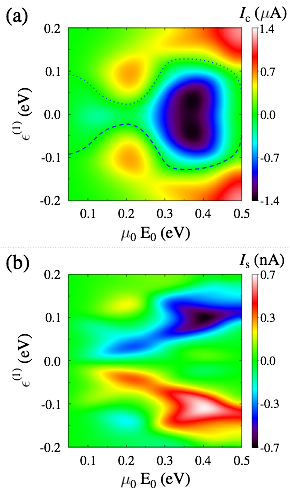
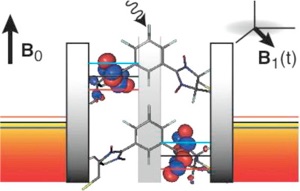
We study theoretically molecular devices where spin rather than charge flux is the measured signal. Of particular interest are spin fluxes manipulated by an external electric field. We proposed a model for a spin field-effect molecular transistor controlled by an external electric field, and utilized ab initio simulations to identify molecular structures for realistic spin-pump applications.
We also studied spin-filtering properties of DNA molecules. This work was inspired by recent experiments on spin-selectivity in DNA junctions - the effect attributed to the Rashba spin-orbit coupling. We showed the possibility of generating pure spin currents in DNA even in the absence of the spin-orbit coupling.
Representative publications:
-
D.Rai and M. Galperin. Electrically Driven Spin Currents in DNA. J. Phys. Chem. C 117, 13730-13737 (2013).
-
B.O. Jahn, H. Ottosson, M. Galperin, and J. Fransson. Organic Molecular Structures for Light Induced Spin-Pump Devices. ACS Nano 7, 1064-1071 (2013).
-
D.Rai and M. Galperin. Spin Inelastic Currents in Molecular Ring Junctions. Phys. Rev. B 86, 045420 (2012).
-
J.Fransson and M. Galperin. Inelastic Scattering and Heating in a Molecular Spin Pump. Phys. Rev. B 81, 075311 (2010). Editors’ Suggestion